
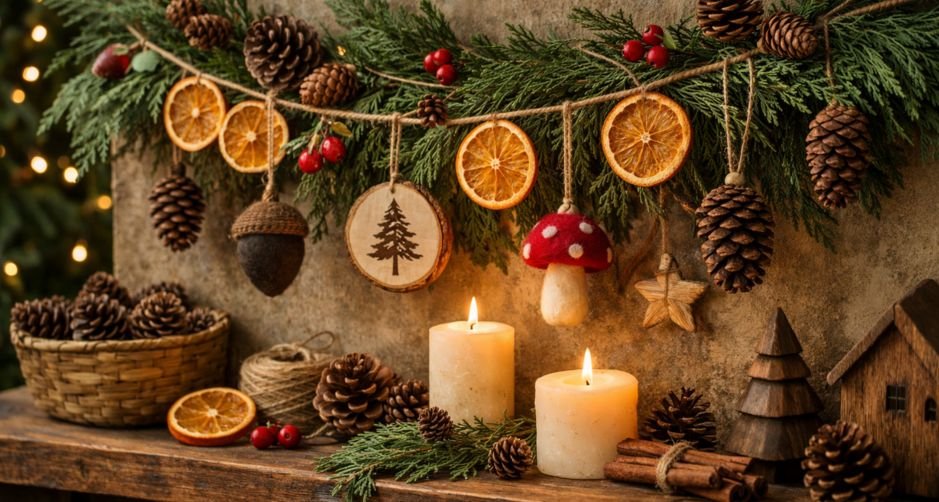
Something peculiar happened in autumn 2024. Whilst major retailers stacked shelves with glittering synthetic decorations, UK consumers started Googling “where to find pine cones near me” in unprecedented numbers.
Between 15 August and 15 September, Google Trends UK registered a 1,327% increase in searches for “sustainable Christmas decorations” compared to the same period in 2023. Pinterest UK reported a 340% year-on-year rise in saves for “natural Christmas wreath ideas” by mid-October.
The revolution wasn’t happening in shops. It was happening in woodlands, parks, and gardens across Britain.
What began as an eco-conscious fringe movement has morphed into something more interesting: natural Christmas decorations have become a luxury status symbol.
The Instagram aesthetic has shifted from maximalist glitter to curated minimalism featuring handmade ornaments and foraged greenery. Suddenly, displaying a £3.99 plastic bauble feels cheap. Hanging a garland you wove from garden cedar? That’s aspirational.

The Hidden Costs of Conventional Christmas
Here’s what the festive decoration industry would rather you didn’t calculate. The average UK household spends £87 annually on Christmas decorations, according to a 2023 YouGov survey.
Roughly 70% of these items are synthetic, manufactured overseas, and designed to last one to three seasons before colours fade or components break.
That’s £60 per household, per year, on decorations destined for landfill within 36 months. Multiply this across 28 million UK households and you’re looking at £1.68 billion spent annually on temporary festive plastic.
Meanwhile, a Saturday afternoon walk yields free pine cones, fallen branches, and berries. A bag of oranges costs £2 and becomes a garland worth £30 in John Lewis. The mathematics suddenly look different.
Natural materials also sidestep the hidden health costs of synthetic décor. Research published in Environmental Science & Technology (2022) found that PVC-based decorations release phthalates when exposed to heat from fairy lights, degrading indoor air quality throughout December.
Wood doesn’t off-gas. Fresh greenery like pine and cedar contributes pleasant natural scent rather than synthetic fragrance. Your lungs notice the difference, even if you don’t.
The Luxury of Authenticity
Touch matters more than we admit. Run your fingers across mass-produced plastic and you feel uniformity, smoothness, fakeness. Touch a hand-carved wooden ornament and you feel grain, and imperfection. This tactile authenticity explains why natural Christmas decorations now dominate aspirational lifestyle content.
The trend mirrors broader shifts in luxury consumption. Just as Ganni and Reformation made sustainable fashion desirable by making it beautiful first and ethical second, natural Christmas décor succeeds because it looks better, not just because it’s “good.” The environmental benefits are the bonus, not the sell.
This matters for how you approach decorating. Don’t think “sacrifice for sustainability.” Think “upgrade to something better.”
Creating Cedar-Leaf Garlands That Last
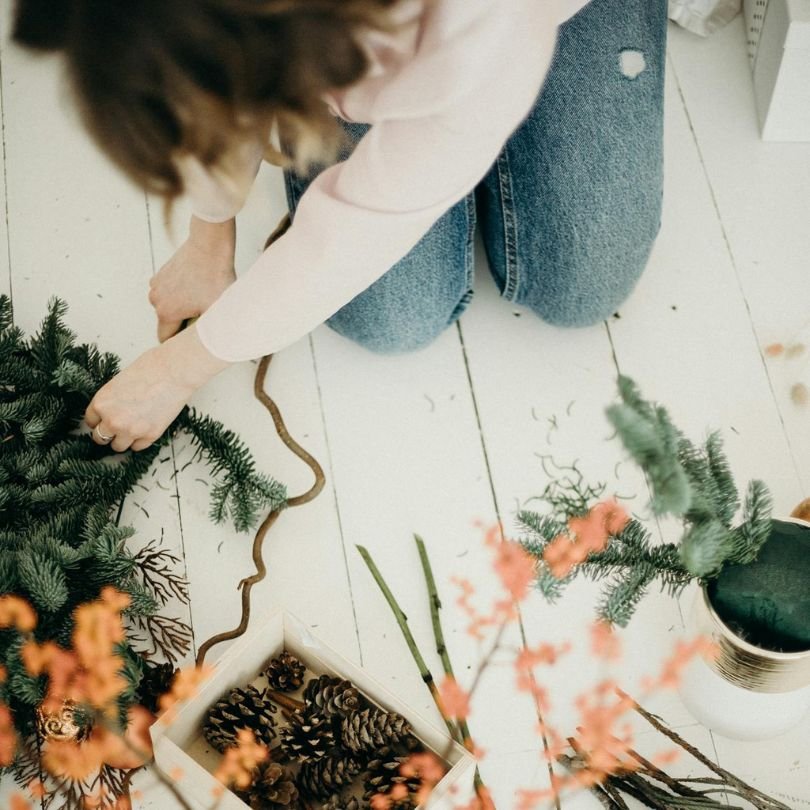
Cedar garlands draped across mantels and doorways capture Christmas magic whilst remaining fragrant for four weeks indoors. Making them takes patience but requires no special skills.
Forage cedar branches with permission from landowners (the Forestry Commission provides guidelines on responsible foraging in UK woodlands).
Choose stems 15-20cm long with dense, healthy foliage. Gather more than you think you need. You’ll need thin florist’s wire (available at any craft shop for under £3) and natural jute twine.
Cut the twine to your desired garland length plus 30cm for hanging loops. Working in 20cm sections, bundle three to four cedar sprigs facing the same direction with stems overlapping.
Wrap the florist’s wire tightly around stems where they meet the twine base, making several passes to secure. Cover the visible wire by wrapping twine over it.
Move along your base string, adding the next bundle so foliage overlaps the previous section’s stems. This creates fullness. Work rhythmically. Bundle, wire, wrap. Bundle, wire, wrap. The repetition becomes meditative.
Finish by weaving in accent materials. Small pine cones add texture. Rose hips provide colour pops. Dried orange slices catch light. When the garland dries out in January, compost it. Next year, make another.
Dried Orange Garlands (And Why They Went Viral)
The combined hashtags #driedorangedecor and #driedorangegarland have accumulated over 847 million views on TikTok. The popularity makes sense. These garlands transform 5p-per-slice fruit into translucent amber discs that glow when backlit, creating effects you cannot achieve with plastic.
Slice the citrus into 5mm rounds. Thinner breaks easily; thicker takes longer to dry. Pat the slices dry with kitchen towel, removing excess moisture that causes browning.
Arrange on parchment-lined baking trays without overlapping. Bake at 100°C for two to three hours, flipping at the halfway mark. Your kitchen fills with a warm citrus scent. Slices are ready when they feel dry and slightly leathery, not sticky. Rest on cooling racks for three to five days to complete dehydration. Thread onto jute string using a tapestry needle, spacing at regular intervals or clustering for visual drama.
These garlands last the entire season. Hang them in windows where afternoon sun backlights them. Drape them on trees. Wrap them around banisters. Photograph them for Instagram because they genuinely look incredible.
Come January, compost them or simmer with cinnamon for natural room fragrance.

Reusable Ornaments With Heirloom Potential
Ornaments that survive decades become family treasures, accumulating stories and meaning beyond their materials. Creating your own ensures uniqueness whilst avoiding the landfill lottery of cheap imports.
Felt wool ornaments bring soft texture and jewel-like colour. Purchase wool roving in festive shades (forest green, burgundy, cream, mustard) from craft suppliers or online for £8-12 per 100g. Use barbed felting needles (£5 for a starter set) to sculpt three-dimensional shapes: acorns, toadstools, miniature Christmas trees, or abstract balls. Add twine loops for hanging. These improve with age, developing character through years of handling.
Salt dough ornaments cost virtually nothing. Mix two parts flour with one part salt and one part water. Knead until smooth. Roll to 5mm thickness and cut shapes using cookie cutters. Pierce hanging holes with a wooden skewer before baking at 120°C for two to three hours until rock-hard. Paint with acrylics or leave natural. Seal with varnish for longevity. These can last 20+ years with care.
Wood slice ornaments offer raw beauty. Purchase pre-drilled rounds from craft suppliers (£1-2 each) or cut from pruned branches left to dry for six months. Sand edges smooth. The surface invites personalisation: wood-burn designs, paint minimalist patterns, or leave completely natural. Thread with ribbon. Each piece looks distinct because wood grain never repeats.
Ethical Brands Worth Supporting
Time constraints are real. Not everyone can forage and craft. Supporting sustainable businesses then becomes the most important choice.
Ten Thousand Villages (global fair-trade retailer, ships to UK, £15-40) has operated for 77 years, working directly with artisan communities in 38 countries. Their FSC-certified wooden ornaments (£8-15), hand-felted wool decorations from Nepal (£12-25), and palm leaf garlands (£28) each include maker stories. UK shipping takes 10-14 days.
Fair Trade Winds (US-based, Fair Trade Federation member, £20-50) guarantees artisans receive at least 50% above local living wages. Hand-carved wooden angels from India (£22), felted Nativity sets (£45), and soy candles (£18) all come with maker profiles. UK delivery within two weeks.
Nkuku (UK-based, Brighton, £12-60) produces contemporary designs using reclaimed wood and recycled brass. Their pyramid tealight holders (£14.95) and geometric wooden trees (£28-42) work year-round. The company maintains direct producer relationships and publishes transparent sourcing information. Next-day UK delivery available.
For ultra-local options, search “sustainable Christmas decorations + [your city]” or use Instagram hashtag #UKMakerChristmas to find small British businesses shipping plastic-free ornaments nationwide.

Making Decorations Last Beyond December
Natural decorations resist the tyranny of seasonal relevance. With slight adjustments, they transition seamlessly into winter décor through February.
Remove obviously festive elements (red ribbons, Christmas-specific ornaments) from pine cone garlands and they become sophisticated winter décor.
Cedar boughs in vases look gorgeous throughout January. Wooden ornaments work as gift tags year-round or permanent shelf styling.
Dried citrus becomes pot pourri when combined with cinnamon sticks and star anise, or serves as edible cocktail garnish.
Storage determines longevity. Pack natural decorations in breathable cotton bags or cardboard boxes, never sealed plastic where moisture breeds mould. Label clearly and store in cool, dry locations.
Next December, your decorations return with patina and memory.
When Foraging Isn’t Feasible
Not everyone can spend Saturday afternoons collecting pine cones. Urban flat dwellers without gardens face different realities. Mobility issues make woodland walks impossible for many. Demanding work schedules or caring responsibilities leave little crafting time.
These constraints don’t exclude you from natural decorating. Focus on what works for your
situation:
Urban adaption: Purchase small bundles of dried materials from florists or craft markets. Many independent shops sell pre-foraged pine cones, branches, and dried oranges. A single bought bundle (£8-15) combined with one or two DIY elements still reduces plastic waste significantly.
Time-poor solutions: Ready-made ethical decorations from brands like Nkuku or Ten Thousand Villages take zero crafting time whilst supporting sustainable businesses. Quality wooden ornaments cost more upfront but last 20+ years, making them cheaper long-term than annual plastic purchases.
Accessibility modifications: Dried orange garlands require only sitting at a table to thread pre-baked slices. Salt dough ornaments need minimal physical effort. Many natural decoration techniques work brilliantly as seated activities or can be adapted for different abilities.
The goal isn’t perfection or complete transformation. It’s making the swaps that suit your life. Even one natural element amongst traditional decorations moves things in the right direction.
Your First Swap Starts Today
Transforming your approach doesn’t require total upheaval. Pick one area this year. Perhaps you’ll forage greenery for your mantel rather than buying a synthetic garland.
Maybe you’ll spend a Sunday afternoon slicing oranges with your children, creating decorations that cost £2 in materials. Or you’ll simply purchase one quality wooden ornament instead of five plastic ones.
Each choice compounds. What begins as “I’ll try making one thing” evolves into “I prefer making things” and eventually into “why would I buy disposable decorations?”
The most compelling aspect of natural Christmas decorating is how it reframes the holiday itself. Your decorations become activities, not purchases. Creating them becomes the celebration. By Boxing Day, you remember the afternoon you spent wiring cedar branches or the morning walk where you collected pine cones. You don’t remember clicking “add to basket” on Amazon.
Share your experiences below. What natural materials work best in your climate? Have you discovered local suppliers or brilliant repurposing hacks? Your insights might inspire someone’s
first sustainable swap.
This Christmas, choose decorations that tell stories rather than generate waste. The planet improves. Your bank balance thanks you. Your home feels more authentic. Everyone wins.
YOU MIGHT ALSO LIKE:
- What Do I Want for Christmas? 40 Gift Ideas to Inspire Your Wishlist
- Turn Your Christmas Tree Upside Down: A Festive Rebellion Against Tradition
- 15 Genius Holiday Beauty Hacks: Your Ultimate Pre-Party Skin Survival Guide
- 20 Unique Gifts Every Movie Lover Will Treasure: An In-Depth Guide
- TikTok’s Most Viral Health and Wellness Trends from 2024: What Actually Works?
- The Great Lock-In: The Viral Trend Taking Over Autumn