

Every October, sunscreen gets demoted. It moves from the front of the bathroom shelf to the back, somewhere behind the dry shampoo and a candle nobody has ever lit. The logic feels sound at the time. It’s dark when you leave the house, it’s dark when you get home, and the sky in between is the colour of old dishwater. So why bother?
I used to only wear SPF in the summer, or if I’m being honest, only on hot and sunny days and when I was on holiday. It was my son who pointed out that I should be wearing it every day of the year. Then it started popping up all over my Instagram too. So I thought I’d do some proper research into it
Here’s what the NHS actually says, what’s worth your money, and the sunscreen that has earned a permanent spot in my skincare routine.

The short answer
Yes. You need SPF in winter in the UK, though probably not as much as you think, and not for the reason most people assume. The NHS says UK sunshine is strongest between 11am and 3pm from March to October. That’s the window for serious burning. Outside it, the risk of a proper lobster-pink burn in Manchester in December is low. I’m not going to pretend otherwise. Burning is not the whole story, though.
UVA doesn’t take the winter off
Sunlight carries two kinds of ultraviolet that matter for your skin. UVB is the one that burns you,
and it drops sharply in the darker months. UVA is the one that ages you, and it’s far more
stubborn. UVA gets through cloud. It also gets through glass (opens in new tab), which means your desk by the office window and your commute on the top deck of the bus both count.
The NHS puts it bluntly: you can burn in the UK even when it’s cloudy. Nobody gets a burn on a train in January. What you do get, slowly and without noticing, is the kind of damage that shows up years later as pigmentation and fine lines. Stress gets blamed for a lot of foreheads. It isn’t always stress. The winter UV index here often sits at 0 to 2 (opens in new tab), which sounds reassuring. Low isn’t zero, and those low doses add up across five months.
When you can skip it (and when you can’t)
I’m a realist. If you’re spending a Sunday on the sofa with the blinds down and the TV on, you don’t need to slather on factor 50.
These are the days to wear it without fail:
Any day you’re outside for more than an hour, whatever the weather
Anything involving snow, because it bounces light back up at your face
Winter sun holidays, obviously
The morning after a retinoid or an acid, since those leave skin more sensitive
Long drives, when the side window is right next to your face That last one surprises people. Look up “driver’s side ageing” if you want a fright.
What to look for on the label
The NHS recommends at least SPF 30 with at least 4-star UVA protection. The stars matter. Don’t skip the UVA part, because the SPF number on its own only tells you about UVB. In winter, that’s the one that counts. Look for the circled “UVA” logo or the star rating on the back of the pack. UK and EU sunscreens show one or the other, and it’s usually in tiny print near the barcode. If a product shouts about its SPF on the front and hides its UVA rating on the back (or doesn’t have one at all), put it down.
Texture matters more in winter than in summer. Skin dries out the minute the heating goes on, and a matte, mattifying sun cream that works in July can feel like a face mask by November. Go creamier from October onwards.
Get more from Lucy Loves Me
Beauty finds, film and TV picks and the trends worth your time, every week.
No spam. Unsubscribe any time.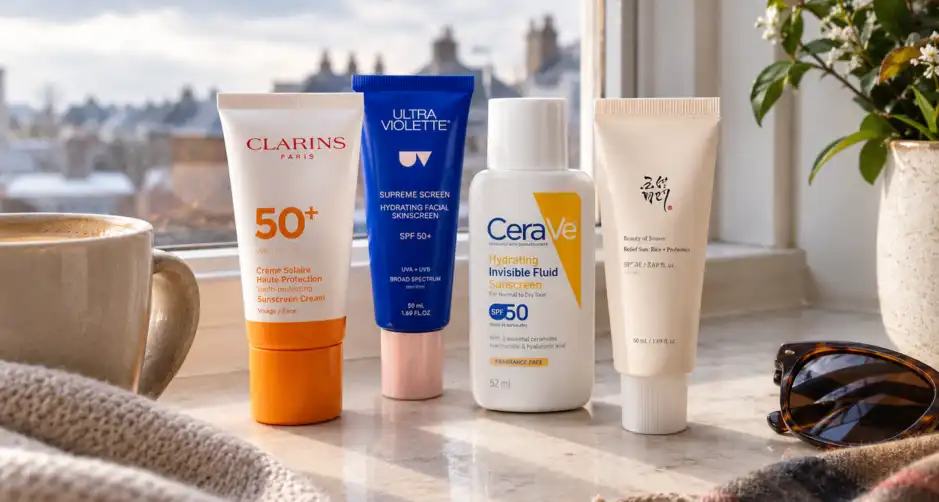
The one I actually use
I use Clarins Youth-Protecting Face Sunscreen High Protection SPF50+ (opens in new tab) £27. My mum has been using this for years and recommended it. I like the fresh scent, it sinks into my skin easily and is a great primer for makeup. It does leave my skin quite glowy so I tend to use setting powder after applying foundation.
As much as I love the Clarins SPF, I’m always open to trying something new, so here are a few other options at different price points:
La Roche-Posay Anthelios UVMune 400 Invisible Fluid SPF50+ £22.50
The UVMune 400 range uses Mexoryl 400, which La Roche-Posay (opens in new tab) says is designed to protect against ultra-long UVA, and the fluid is lightweight and suitable for sensitive skin.
Beauty of Joseon Relief Sun: Rice + Probiotics SPF50+ PA++++ £15.50
A Korean favourite (opens in new tab) that’s much more like a moisturising skincare product than the sunscreen you remember from school. It’s hydrating, has a comfortable finish and is particularly appealing if you hate that traditional sunscreen feeling.
Garnier Ambre Solaire Super UV Anti-Age SPF50+ £10
Proof that you don’t need to spend a fortune on facial SPF. This is a good option (opens in new tab) for those who want high protection without adding another luxury-skincare price tag to the bathroom shelf.
Ultra Violette Supreme Screen Hydrating Facial SKINSCREEN SPF50+ £34
Ultra Violette describes Supreme Screen (opens in new tab) as a three-in-one SPF, moisturiser and primer, with a soft, creamy texture and satin finish. It’s particularly suited to dry, normal and combination skin, so I can see why it works well as a winter SPF when the heating has already sucked the life out of your skin. It also sits nicely under makeup without leaving a white cast.
CeraVe Invisible Hydrating Fluid Sunscreen SPF50 £17.90
The lightweight fluid gives UVA and UVB protection while containing three essential ceramides, niacinamide and CeraVe’s MVE technology (opens in new tab) to help support the skin barrier. It’s designed for normal to dry skin, absorbs quickly and is suitable under makeup, making it a particularly good shout for colder, drier months.
Whatever you pick, the best sunscreen is the one you’ll wear every morning. That’s it. A £40 serum-SPF you’re scared to waste is worse than a £6 supermarket tube you use without thinking.
Does SPF in makeup count?
Sort of, but mostly no. Foundation with SPF 15 in it sounds like a two-for-one, but you’d need to put on far more foundation than anyone wears to get the protection printed on the bottle. Treat SPF in makeup as a bonus. It should never be your only layer.
The order is simple. Moisturiser, then sunscreen, then a couple of minutes’ wait, then makeup. If you’re topping up later in the day, a powder or mist with SPF (opens in new tab) over the top is fine for an office day in November. It won’t save you on a ski slope.

What about vitamin D?
This one comes up constantly, usually from someone who’s heard that sunscreen blocks vitamin D. Here’s the thing. From October to March, UK sunlight isn’t strong enough for your skin to make much vitamin D anyway, which is why the NHS advises everyone to consider a daily supplement through the autumn and winter (opens in new tab).
Skipping sunscreen in December won’t top you up. It’ll just age your skin while you wait for spring. I’m not a doctor, and if you’re worried about your levels, your GP is the person to ask.
The winter SPF mistakes almost everyone makes
The first is treating sunscreen as a summer product. It lives in the holiday bag with the after-sun and the flip-flops, comes out for a fortnight abroad, and sits in a drawer for the other fifty weeks. The second is trusting a moisturiser with SPF 15 on the tub. Most of us use a pea-sized blob, and SPF testing assumes a much thicker layer than any normal person applies. The British Skin Foundation suggests (opens in new tab) a two-finger rule for face and neck, and about a shot glass (30 ml) for the body. Reapply every two hours outdoors, and after swimming or sweating.
Then there’s the neck. Plenty of people do their face beautifully and stop dead at the jawline. The neck and the backs of the hands never get a look in. Those are the bits that give the game away, and they get just as much light on the school run as your cheeks do.
The last one is the most British mistake of all: deciding whether to wear sunscreen by looking out of the window. Grey sky, no sunscreen. Blue sky, maybe. UVA doesn’t care what the sky looks like.
So hopefully, like me, you will add this extra step into your daily routine no matter how grey and rainy it is outside.
It takes about a minute in the morning, after moisturiser and before makeup, with whatever’s left rubbed into the backs of your hands. Keep the bottle at the front of the shelf. The candle can go at the back.
DISCLAIMER: The content and information on Lucy Loves Me is intended for entertainment and educational purposes only. It should not be taken as professional medical advice, diagnosis, or treatment. Always consult with a qualified healthcare provider for guidance regarding any health-related concerns or before starting a new diet, exercise regimen, or wellness program. Lucy Loves Me does not make any claims to prevent, cure, or treat any medical conditions.