


If you’ve ever washed your hair in a hotel in the Lake District and come home wondering why it suddenly behaved, the answer is probably in the pipes. Hard water hair in the UK is a genuinely regional problem, and where you live has a lot to do with how your hair feels after a wash.
The water where I live is very hard, and my hair can often feel dry. So, this one is personal. The real questions are what’s going on in the water, and whether the fixes on sale are worth the money.
What hard water actually is
Hard water is water carrying a lot of dissolved calcium and magnesium. It picks them up as it moves through rock like chalk and limestone, and it keeps them all the way to your shower head.
Water companies measure it in milligrams of calcium carbonate per litre (mg/l). United Utilities, which supplies the North West, uses this scale: under 75 mg/l is very soft, 75 to 125 is soft, 125 to 250 is moderately hard, 250 to 375 is hard, and anything above 375 is very hard.
None of this is a health risk. Thames Water points out that hard water isn’t considered harmful and says the minerals in it are good for us, especially for our bones. Your kettle and your hair may disagree.

Why London’s water is so hard
Thames Water says it takes about 65% of its water from rivers and 35% from underground sources, and that the water passes through soft chalky limestone many times along the way.
The result, in its own words, is that most of the water in the South-East of England is hard. London sits right in the middle of that. Independent postcode checkers that use supplier data typically put London somewhere around 250 to 310 mg/l, which lands it in the very hard band on the United Utilities scale.
Thames Water’s own table runs from soft, up to 100 mg/l, to very hard, over 300 mg/l, and some parts of the capital sit close to that top line. Hard, then. If you’ve moved to London and wondered why your shower screen looks like it’s been frosted, this is why. The same mineral film is sitting on your hair.
Why Manchester’s water doesn’t do the same
Manchester is a different story. United Utilities says most of its raw water comes from upland reservoirs, and because that water has had little contact with mineral-rich rock, supply across the North West is mostly soft or very soft. Rain falls on the hills, collects in reservoirs like Haweswater and Thirlmere in the Lake District, and reaches Manchester without much time to pick anything up.
It’s why moving from one to the other can make such a difference to how your hair feels. Scotland and much of Wales have soft water too (opens in new tab), so the North and South divide is a real thing, at least in the bathroom.
Get more from Lucy Loves Me
Beauty finds, film and TV picks and the trends worth your time, every week.
No spam. Unsubscribe any time.
What hard water does to your hair
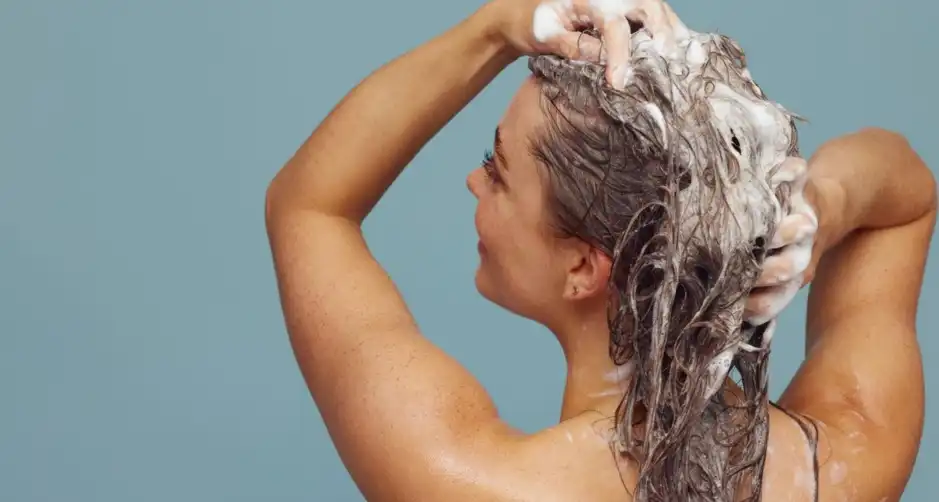
Here’s the mechanism, minus the jargon. Calcium and magnesium react with the cleansing agents in shampoo and soap, which means less lather and more residue, and it’s why a shampoo that foams up beautifully in a soft water area can feel oddly flat and squeaky in a hard water one. Some of those minerals are left behind on the hair shaft as a thin film. That film can make hair feel dry and look dull. It can make it harder to rinse clean, and it can stop conditioner doing its job properly.
There’s some evidence, at least. A 2018 study in the International Journal of Trichology (opens in new tab) by Luqman and colleagues tested hair samples from 70 men in Pakistan. Hair treated with the hardest local water lost a statistically significant amount of tensile strength compared with untreated hair, while hair treated with deionised water didn’t change.
The authors concluded that hard water decreases hair strength and increases breakage. It’s one small study, done in a lab, using the hardest water the researchers could find locally. I’d treat it as a reason to take the problem seriously, not as proof that London water is snapping your ends off.
Chelating shampoo: what it is and who needs it
A chelating shampoo contains ingredients that bind to metal ions like calcium and magnesium, so they rinse away with everything else when you wash. On an ingredients list, look for disodium EDTA, tetrasodium EDTA, sodium phytate or citric acid near the top. It’s a step up from a clarifying shampoo.
Clarifying shampoos strip product build-up and oil, and some also include chelating agents, but not all of them do, so it’s worth turning the bottle over before you assume it will deal with minerals.
I haven’t tried one yet, so this isn’t a review. What I can tell you is what’s on the shelf and how it’s meant to be used. Two names come up again and again. Malibu C Hard Water Wellness Shampoo (opens in new tab) £15.57 is sold specifically as a chelating shampoo for mineral build-up. Olaplex No.4C Bond Maintenance Clarifying Shampoo (opens in new tab) £30 is sold as a clarifying shampoo for build-up
I would treat it as a once-a-week or once-a-fortnight wash at most, followed by a good conditioner, because anything strong enough to strip minerals can be drying on its own. Every day is overkill.
Do shower filters work for hard water hair?
This is where I’m sceptical. Plenty of shower filters are sold to people in hard water areas (opens in new tab), but many are designed mainly to reduce chlorine, and reducing chlorine is not the same as removing calcium and magnesium.
Before buying one, read the product page closely. If it doesn’t say it reduces calcium and magnesium, and give a number, I’d assume it doesn’t do much for hard water. A whole-house water softener is the solution that removes hardness, but that’s a plumbing job and a much bigger spend.
Cheaper things worth trying first
You don’t have to spend a fortune to see whether hard water is behind your dry hair. Use a bit less shampoo and lather it properly in your hands before it goes on your hair. Rinse for longer than feels necessary. Then condition, every time, concentrating on the mid-lengths and ends where dryness shows first. A final rinse with cooled boiled water from the kettle, or bottled water, is fiddly and slightly ridiculous on a busy weekday morning, but it’s a free experiment that tells you a lot.
If your hair feels noticeably softer, you’ve got your answer. Some people swear by a diluted apple cider vinegar rinse. I’d go gently with that one, because it’s a folk remedy with no strong evidence behind it, and vinegar in your eyes is its own kind of hard.
Check your own postcode
You can check how hard the water is in your area (opens in new tab) using your postcode, so start there. The number tells you if hard water is really the culprit, or if something else is drying your hair out, like heat styling or the central heating. If your number comes back over 250 mg/l, a chelating wash every week or two is a sensible experiment. If it comes back soft, save your money and look elsewhere.