

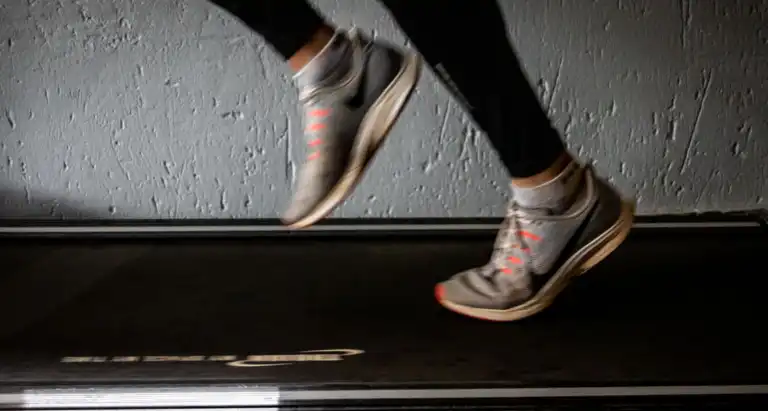
Every January, somebody in a one-bed flat buys a treadmill. By March it’s a clothes horse with a safety key. The walking pad vs treadmill question looks like a fitness decision, and in a house with a garage it probably is. In a rented flat with a neighbour underneath and a hallway the width of a wheelie bin, it’s mostly a question about furniture. Where does it go? Who hears it? Can you get it up the stairs? Too many comparisons are written by people with a spare room. This one assumes you haven’t got one.
What you’re actually choosing between
A walking pad is a treadmill with the top half missing. No console, no arms, a slim motor housing at the front and a remote control you will lose down the sofa. Most are built for walking only. Which? tested a batch in January 2026 (opens in new tab) and found most pads top out at around 8km/h, which is a brisk walk or a light jog. Plenty stop at 6km/h. The faster ones exist, going up to 12km/h, but Which? says they feel less stable.
A treadmill gives you a longer belt, a frame to grab and a motor that can cope with running. Decathlon’s Domyos Compact RUN100 (opens in new tab) reaches 14km/h and the RUN500 (opens in new tab) goes to 16km/h.
So, bluntly: do you run? If you do, or you honestly intend to, a pad will frustrate you inside a fortnight. If you want to walk while you watch telly or answer emails, a treadmill is a lot of machine for the job.
What each one costs
Walking pads are cheap now. Decathlon lists them from £89, and the CitySports Electric Walking Pad (opens in new tab) that Which? reviewed is £95 there. Spend more and you get a sturdier build: Argos sells the Opti Compact Walking Treadmill (opens in new tab) at £349, and the JTX Movelight (opens in new tab) is £499 direct from JTX.
Treadmills start higher and climb fast. Decathlon’s own-brand range runs at £499.99 for the Compact RUN100, £549.99 for the T520B and £699.99 for the RUN500. (Prices checked on 14 October 2026, and they move about.) That makes a decent treadmill roughly five times the price of a basic pad.
Running costs barely matter. Under the Ofgem price cap for October to December 2026, electricity is about 26.32p per kWh. A 440W pad running flat out for an hour would use 0.44kWh, so under 12p. An 800W treadmill motor at full pelt comes in around 21p. Pennies, then. Real use draws less than the motor’s maximum, so treat those as ceilings.
Walking pad noise and the neighbours downstairs
This is the section that decides it for most flats. There are two kinds of noise. One is the motor and belt, a steady hum that mostly stays in your room. The other is your feet, and that one travels through the floor into somebody else’s ceiling.
Decathlon publishes figures for its treadmills. The RUN100 is rated at 65dB at maximum speed, and the T520B at 70dBA measured a metre away at 13km/h with nobody on it. Add a runner and the thud of each footfall, and you can only guess how that goes down at 6.30am.
Get more from Lucy Loves Me
Beauty finds, film and TV picks and the trends worth your time, every week.
No spam. Unsubscribe any time.Walking is gentler. One foot is always on the belt, so there’s no landing from a height, and that is the single biggest argument for a walking pad in a small flat.
The law is vaguer than people think. Councils can investigate noise as a statutory nuisance at any time of day if it unreasonably and substantially interferes with someone’s use of their home. Between 11pm and 7am there’s a harder line: gov.uk guidance sets a permitted level of 34dBA, measured inside the complainant’s home, where the background level is 24dBA or lower.
Ignore a warning notice and the fixed penalty for a dwelling is up to £110. Nobody is getting fined for a lunchtime walk. But your tenancy agreement almost certainly has a clause about nuisance to neighbours, and a landlord reads that clause more often than a council officer reads a decibel meter.
The best walking pad in the UK for a flat is simply the quietest one you can afford. A few things help. Put a thick rubber mat under the machine, since Decathlon notes a protective mat reduces vibration. Stand it on the most solid bit of floor you’ve got. Walk in trainers, keep it to daytime, and knock on the door downstairs before you buy. It’s an awkward two minutes, but it’s also cheaper than a returns courier.
Where it lives when you’re not on it
Measure before you fall for anything. Pads win this easily on paper. The CitySports model Which? tested is 11cm high, 72cm wide and 146cm long, and weighs 18kg. That goes under most beds and some sofas, and one person can move it. The JTX Movelight is 13cm high and 30kg, which is heavier than it sounds when you’re tilting it at an angle on a rug. Check the gap under your own bed first. Divans have none. Folding treadmills are sneakier than they used to be. The Domyos Compact RUN100 folds flat to 14cm high, the same sort of profile as a pad, but it’s still 150cm long, 75cm wide and 41kg.
Many others fold upright instead, which leaves a tall thing leaning in the corner of your living room for ever. In use, both need more room than their footprint. Which? advises keeping the back of the belt clear of walls and furniture, and Decathlon says the same about leaving space behind a treadmill to step off safely. In a small room, that clearance is the bit people forget. Then there’s the stairs. A 41kg box up three flights with no lift is a two-person job and a test of any friendship.
Will the floor take the weight?
Almost certainly, yes. British Standard BS 6399-1 sets the design load for domestic floors at 1.5kN per square metre, which works out at roughly 150kg on every square metre of the room at once.
A 41kg treadmill with a person on it sits within what a sound floor is built for. Weight is the wrong worry, then. Vibration is the right one, especially on the bouncy timber floors of a Victorian conversion, where you’ll feel the bookcase join in. None of this is structural engineering advice. If your floor already dips or creaks badly, ask the landlord or managing agent before you add a motor to it.
Is a walking pad worth it?
For walking, yes. The NHS backs the walking part (opens in new tab). Its guidance for adults is at least 150 minutes of moderate intensity activity a week, and brisk walking counts. The test it gives is a good one: you can still talk, but not sing. A 6km/h pad gets most people to that point. The NHS also says to break up long periods of sitting, which is the whole pitch for strolling through a meeting with your camera off.
Where a pad falls down is ambition. Most won’t let you run. Decathlon suggests a belt of 110cm to 120cm for steady walking, so if you’re tall, check the belt length against your stride before you order.
The one I’d pick for a flat
A walking pad, and I don’t think it’s close. It’s a fifth of the price and it disappears under the bed or the sofa. Walking is also kinder to whoever lives below.
Buy the treadmill only if you already run outdoors, live on the ground floor or have a concrete slab under you, and can leave it set up. A treadmill you have to unfold is a treadmill you’ll stop unfolding.
And if neither fits? The pavement is free, and nobody underneath it can hear you. A machine indoors only earns its space on the days you wouldn’t have gone out anyway, and in Britain between now and March that’s a fair few of them.
Read next
10 Powerful Antioxidant Foods for Radiant Skin and Anti-Ageing Benefits
Turning Up the Chill: Bala Bangles and the Lazy Girl Workout Take Over TikTok