
My skin has started to feel like it belongs to someone else. A skincare routine built around hormonal change is one of those things plenty of UK women never think about until the moisturiser they’ve used for years suddenly stops working.
Recently I have noticed some changes in my skin despite really taking care of it. I get more breakouts than ever before and they don’t go away quickly either. There are also rogue hairs that were not there before. The shape of my face has changed too: my cheekbones are less pronounced and my chin feels shapeless. Sometimes I am scared to look in the mirror when I wake up to see what else has changed.
I’m in my 40s, I haven’t spoken to a GP, and I don’t know whether this is perimenopause. It might be. It might not. But a lot of what I’ve read sounds familiar, so I’ve been looking into it, and this is the routine I’m building while I find out.
Here’s the thing the beauty counters rarely say out loud. Your skin isn’t failing. If hormones are involved, it’s responding to oestrogen starting to decline (opens in new tab), and the products that worked at 40 were built for skin that had more of it. So here’s a routine built around that, with the reasoning for each step and what it costs.
What can happen to skin during perimenopause and menopause
Oestrogen does a lot of quiet work in your skin. According to the British Skin Foundation (opens in new tab), it supports the skin’s hyaluronic acid, its oil (sebum) production, its ability to hold on to water and the outer barrier that keeps moisture in. When levels fall, all of that slows down at once.
The numbers are bleak. The British Skin Foundation says around 30% of dermal collagen is lost in the first five years after menopause, followed by roughly 2.1% a year after that.
Skin gets thinner and wounds heal more slowly. Dryness tends to show up first on the face, the lower legs and anywhere else oestrogen receptors are concentrated. The NHS lists “skin changes, including dry and itchy skin” among the symptoms of menopause and perimenopause, and says symptoms usually last seven to nine years, sometimes longer. That’s a long time to be using the wrong moisturiser.
The average age of menopause in the UK is 51, per the British Skin Foundation. Plenty of women notice skin changes years before that, during perimenopause (opens in new tab), and often put it down to the weather or the heating. I’m in my 40s, so I’m wondering whether that’s me. Breakouts and stray hairs can also have other causes, which is one reason I’m planning to talk to my GP rather than guess.
The routine I’m using now
I’m a realist about skincare. Most of it is marketing, and menopause has become a very profitable word to stick on a jar, which is why the brands love it. I’m not claiming my own shelf is minimal. I like a few fruity, glowy products, and I’d rather be honest about that.
In the morning I cleanse in the shower with Ole Henriksen Peach Glaze 2% Niacinamide Cleanser £23 (opens in new tab), which feels really fresh and smells divine. Then comes Glow Recipe Watermelon Glow Niacinamide Dew Drops £32 (opens in new tab), my beloved Tatcha The Dewy Skin Cream £69 (opens in new tab) and Kiehl’s Creamy Eye Treatment with Avocado £30 (opens in new tab) (you can see the fruit theme here).
When I get breakouts I leave those areas dry rather than pile on treatments. What follows is the reasoning behind each step, and what I’m thinking about as my skin changes. A long routine on thinning, reactive skin is asking for trouble.
Cleanser: gentler than you think
Foaming cleansers that left your skin squeaky at 35 can leave it tight and itchy as hormones shift, so I look for a cleanser that feels fresh without feeling stripped. I cleanse twice a day whether I’m wearing make-up or not.
If your skin does start to feel tight, itchy or sore, simplify first: fewer steps and gentler washes. The British Skin Foundation recommends fragrance-free washes and moisturisers for menopausal dryness, which is worth knowing if your skin turns reactive. Squeaky isn’t clean. It’s stripped. So I should probably go back to my fragrance free Byoma Creamy Jelly Cleaner £10.99 (opens in new tab).
Moisturiser: the step that does the heavy lifting
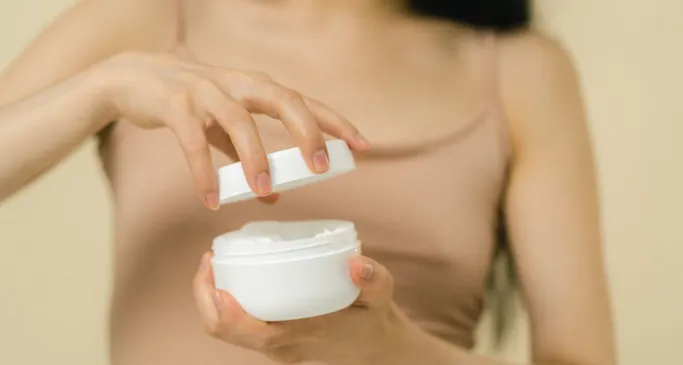
If you change one thing, change this. With less sebum and a weaker barrier, skin needs a moisturiser that replaces what it’s stopped making for itself, and richer is usually better. I’ve used Tatcha The Dewy Skin for about four years and it has worked for me. My favourite, though, is Rodial Dragon’s Blood Velvet Cream £90 (opens in new tab), which is ever so rich. I would happily use it at night, especially when my skin feels dry. A heavier night cream is the easiest swap to make.
Get more from Lucy Loves Me
Beauty finds, film and TV picks and the trends worth your time, every week.
No spam. Unsubscribe any time.If you want a cheaper option, ceramides are a good thing to look for, because they’re a large part of what the barrier is built from (opens in new tab). CeraVe Moisturising Cream £12 (opens in new tab) is the boring, sensible answer, and I mean that as a compliment. It also works on shins that have started flaking under tights, which is handy, because dryness rarely stops at the jawline.
Retinoid at night: slowly, slowly
The British Skin Foundation suggests a topical retinoid at night to boost cell turnover and collagen production. That’s about as close to an official nod as skincare gets. I haven’t tried one yet, but it’s something I’m considering. The catch is that retinoids can irritate, and skin going through hormonal change can already be more easily irritated. Start low. The Ordinary Retinal 0.2% Emulsion £15 (opens in new tab) is a good place to start, so twice a week is plenty to begin with. If your skin stings or peels, back off for a few nights. I haven’t tried this yet.
SPF every morning, even in winter
Collagen is already in decline, so there’s no sense letting UV speed it along. The British Skin Foundation recommends regular sunscreen for exactly this reason. I wrote a whole piece on why you still need SPF in a UK winter, and the short version holds: wear it daily, cloud or no cloud. No days off, even in drizzle. A fluid texture tends to sit better on drier skin than a matte one. I personally use Clarins Youth-Protecting Face Sunscreen High Protection SPF50+ (opens in new tab) £27.
Saggy skin and jowls: are gua sha and face devices worth it?
My Instagram feed has decided I need a gua sha. Every other reel is someone gliding a pink stone along their jaw, or wearing a glowing LED mask, promising a lifted, sculpted face in five minutes a day. Given that my chin feels softer and my cheekbones less defined, I’ll admit I’m tempted.
So I did some reading, and the honest answer is that the evidence is thin. Dermatologists quoted in the press (opens in new tab)say there’s little good research showing that gua sha or rollers can lift sagging skin or change the shape of your face. What you see afterwards is mostly temporary de-puffing. That makes sense when you think about it. Sagging comes from collagen loss and changes in the fat and volume underneath, and a stone moving over the surface can’t rebuild any of that.
That doesn’t make them useless. A little face massage feels lovely, can ease morning puffiness, and might make you more likely to apply your moisturiser properly. If you try it, use it over a rich cream or oil, never dry skin, and keep the pressure light. I’d skip it over active breakouts, and take care if you have rosacea or very sensitive skin.
Devices are more of a mixed bag. Some LED and at-home light devices have a little evidence behind them for fine lines, but less for lifting, and microneedling at home can irritate a barrier that’s already fragile. Look for independent evidence, not just the brand’s own claims. If sagging really bothers you, a consultation with a properly qualified practitioner is where the real lifting options are.
For now, I’m putting my money into the unglamorous bits: SPF, a good moisturiser, and possibly a retinoid. If I do buy a gua sha, I’ll treat it as a nice five minutes, not a facelift.
What I’m keeping an eye on
Some habits that are harmless at 30 can become unhelpful as oestrogen drops, so I’m watching how my skin responds rather than ripping out my routine. Gritty scrubs are the obvious one to avoid. Thinner skin doesn’t need sanding. Fragrance and exfoliating acids are common irritants, so if your skin starts to sting, tighten or itch, they’re the first things I’d pause. I haven’t dropped anything yet, but if my skin turns reactive, that’s where I’ll start.
Then there’s the temptation to buy everything with “menopause” on the label. Some of those products are lovely. Others are a standard moisturiser with a new box and a higher price. Read the ingredients list before you read the marketing.
Dry skin: the bits beyond your face
Hormonal dryness doesn’t politely stay above the neck. Shins, forearms and the backs of hands often go first, and the itch can be maddening at night. A rich body cream after a shower, while skin is still slightly damp, does more than any expensive serum. Short, warm showers help too. Hot water feels wonderful in the colder months and strips oil you’re no longer replacing.
If central heating is making all of this worse, it probably is. I’ve written separately about why skin gets so dry when the heating goes on, and the same thinking applies here: moisturise more often and keep the thermostat a notch lower.

When to see your GP
Skincare can do a lot, but not everything. I haven’t been to my GP yet, but I’m going to book an appointment to ask whether this could be perimenopause, and to rule out other causes. If itching is keeping you awake, or your skin is one of several symptoms getting you down, it’s worth a GP appointment too. The NHS has a section on menopause treatments, and some symptoms are better treated at the source than at the bathroom shelf.
The British Skin Foundation also advises getting any spot, sore or mole that won’t heal (opens in new tab) or that’s changing checked by a GP or dermatologist. Skin that is thinner and drier is more vulnerable to growths, so this matters more now. Don’t sit on it.
The perimenopause skincare question
Perimenopause skincare deserves a mention, because this is where plenty of women get caught out, and where I think I might be. Skin can swing between dry patches and hormonal breakouts (opens in new tab) in the same month, which makes it tempting to pile on spot treatments that dry everything out further. A barrier-first routine, with a gentle cleanser, a decent moisturiser and SPF, gives you a stable base to work from while things settle.
My honest view? The best moisturiser for skin at this stage of life is the one you’ll actually use twice a day, and it doesn’t have to be the priciest on the shelf. There are good options well under £20, and I’ll admit my own shelf leans more towards treats.
For now, I’m keeping things simple and watching how my skin behaves over the next few months. I’m also booking that GP appointment, because what I really want to know is whether this is perimenopause or something else. If you’re noticing similar changes in your 40s, it’s worth asking the question rather than quietly putting up with it.
Read next
Are beauty advent calendars worth it? How to work out the real value
Helix Piercing Guide: Pain, Healing Time, Jewellery & Trends